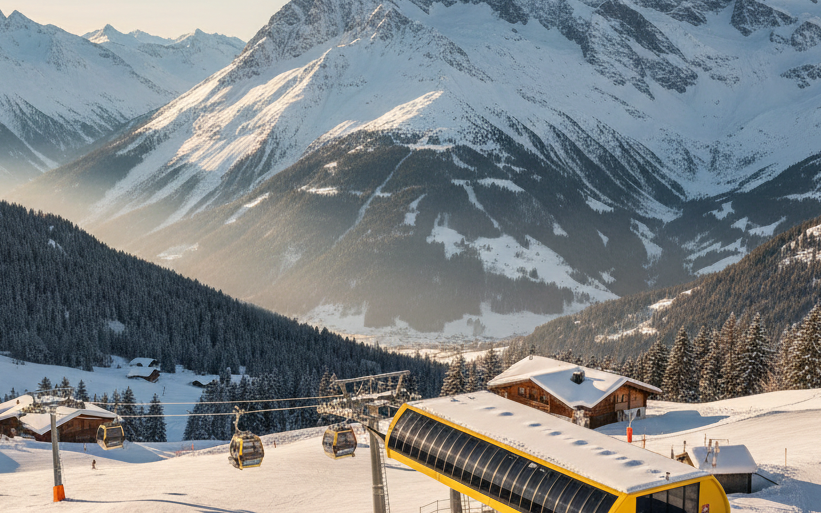
Spread along the Landwasser and Prättigau valleys in the canton of Graubünden, Davos Klosters combines Europe's highest town (Davos at 1,560 m, famous for hosting the World Economic Forum every January) with the traditional chalet village of Klosters (1,191 m, a longtime retreat of the British royal family). Rather than a single linked bowl, the ski pass covers around 270 km to 300 km of pistes across six separate mountains (Parsenn/Gotschna, Jakobshorn, Pischa, Madrisa, Rinerhorn and the historic Schatzalp), climbing from 810 m at Küblis up to 2,844 m on the Weissfluhgipfel. Opened with the Parsenn funicular in 1931, the classic 12 km Parsenn descent from the Weissfluhgipfel to Küblis drops more than 2,000 vertical metres, after which skiers ride the Rhaetian Railway back up.
Each mountain has its own audience: Parsenn offers huge intermediate cruising, Jakobshorn is a freestyle and snowboard hub, Madrisa and Rinerhorn cater to families, and Pischa is now dedicated to unpisted freeride and ski-touring routes. The obvious drawback is fragmentation: only Parsenn is ski-linked between Davos and Klosters, moving between the other five mountains requires town buses or trains, and flat, urban Davos has utilitarian flat-roofed sanatorium architecture that lacks traditional alpine charm.